
CASE STUDY:
Beyond the Brief:
Uncovering Hidden Industrial Asset Liability
SECTOR:
PROJECT DURATION:
LOCATION:
INFRASTRUCTURE
5 MONTHS
NEW SOUTH WALES, AUSTRALIA
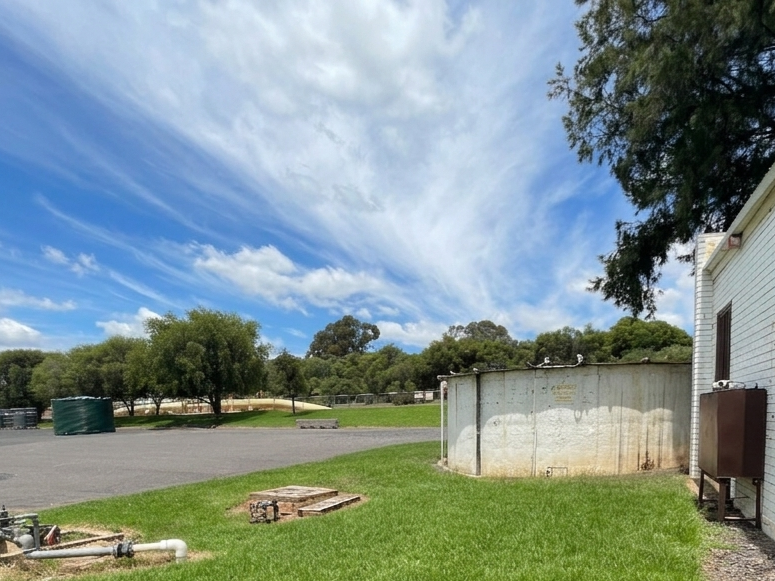
Pacific Systems was engaged by a major critical infrastructure provider to deliver an exploratory operational readiness review at a vital regional energy maintenance depot in New South Wales, Australia. The primary objective of the engagement was to formulate a ten-year strategic roadmap to modernise infrastructure and ensure sustained operational efficiency. Within this broader scope, we uncovered a severe, overlooked structural risk involving an undocumented network of legacy concrete water tanks. Resolving this critical asset vulnerability became a central priority, transforming a hidden multi-million-dollar liability into a structured, prioritised decommissioning program that successfully protected the client's long-term operational resilience without disrupting active operations.
Understanding the Environment
The engagement took place within a highly complex operational and asset management environment. The maintenance depot serves as a critical strategic hub for several interconnected elements that support the broader eastern Australian energy grid. Consequently, the site is defined by complex interdependencies where any operational halt poses immediate, high-stakes cascading risks to regional energy security.
Governance and asset tracking were heavily complicated by the site's history. Established in the 1970s and passing through multiple corporate transitions before its acquisition by the client in the 2000s, decades of structural modifications had obscured institutional memory. Numerous legacy assets completely lacked formal documentation. Furthermore, day-to-day operations involve a diverse group of over 20 internal personnel and up to 50 contractors during peak maintenance windows, creating significant organisational silos between corporate asset managers, project teams, and frontline operational staff.
The Challenge
During our baseline field assessments, Pacific Systems identified a network of decommissioned, above-ground and below-ground concrete water tanks with an estimated capacity of 286 kilo-litres. These legacy assets had faded entirely from the client’s modern asset registers and risk management frameworks.
Left unmanaged, these structures represented an intolerable physical risk. Due to decades of environmental exposure, the concrete had developed profound material degradation and chemical vulnerabilities. Analysis revealed that the advanced structural fatigue, combined with trapped internal pressures, introduced a distinct risk of sudden, catastrophic explosive failure. Because these undocumented tanks were situated directly adjacent to live gas infrastructure and critical transport corridors, an explosive breach threatened to destroy essential operational assets, cause extensive environmental damage, and endanger the lives of on-site personnel.
Our Approach
Pacific Systems deployed a rigorous methodology rooted in systems thinking, root cause analysis, and multi-disciplinary risk assessment to resolve the issue.
Our team executed the investigation across four key stages:
Evidence Gathering and Forensic Research: We performed detailed on-ground physical inspections to map out the exact footprint and structural state of the tank network. We then cross-referenced these findings with historical engineering files and archival site layout plans dating back to 1978 to reconstruct the asset lifecycle.
Stakeholder Facilitation: We conducted focused alignment workshops with station managers, structural engineers, and corporate risk officers. This process bridged communication gaps between siloed teams, establishing a shared understanding of the operational threat.
Risk and Framework Modelling: Utilising an impact prioritisation matrix, we formalised the technical findings into a data-driven business case. This quantified the hidden liability and justified immediate executive intervention.
Solution Design: Pacific Systems designed a phased decommissioning strategy, seamlessly integrating the demolition works into a broader infrastructure revitalisation program to reduce costs and any impact to site.
Outcomes and Impact
By surfacing and analysing this critical vulnerability, Pacific Systems delivered substantial long-term benefits to the organisation's resilience and corporate governance:
Reduced Risk Exposure: The primary hazard was completely mitigated through the successful inclusion of the asset network into a prioritised, funded decommissioning program.
Stronger Governance and Compliance: The project eliminated a hidden structural liability and updated the client's risk registers to accurately reflect modern safety standards.
Improved Executive Visibility: Leadership gained clear oversight of legacy infrastructure risks, enabling more strategic, forward-looking capital investment planning.
Greater Stakeholder Alignment: The engagement unified corporate asset managers and site operations teams around a shared, practical methodology for addressing unmapped historical liabilities across the business.
FOCUS: ASSET LIFECYCLE, SYSTEMS THINKING AND OPERATIONAL RISK ASSESSMENT, CROSS-FUNCTIONAL STAKEHOLDER FACILITATION AND ALIGNMENT, STRATEGIC INFRASTRUCTURE PLANNING AND CAPITAL PROGRAMMING, FRAMEWORK DEVELOPMENT AND PRIORITISATION MODELLING, INSTITUTIONAL MEMORY RECOVERY AND ASSET TRACKING GOVERNANCE